Tuesday, August 29, 2017

ZTE V0721 gets TENAA certified with octa-core CPU, could be a V7 Lite successor

ZTE V0721 gets TENAA certified with octa-core CPU, could be a V7 Lite successor


A new ZTE smartphone has been certified by China's TENAA. Listed as V0721, the device is powered by an SoC with octa-core, 1.3GHz processor, and sports a 5.2-inch Full HD display. RAM is 3GB, while internal memory is 32GB. The camera department features a 13MP rear unit and a 5MP front shooter. There's a rear-mounted fingerprint sensor as well. The phone runs Android 6.0 Marshmallow and packs in a 2,540mAh battery. Size-wise, the phone measures 146.1 x 72.6 x 8.25mm and weighs in at 138g. Color options include silver gray and gold. It's worth mentioning that from last year was V0720, so the V0721 could well be a successor to that device. |


Monday, August 28, 2017

Essential phone to finally reach customers' hands on August 31

Essential phone to finally reach customers' hands on August 31


Last week, it was officially that shipments for have begun. While it was certainly good news, those who pre-ordered the phone were put off see that the tracking info the company shared didn't provide any estimate on delivery. That's, however, changing now, as those with tracking info are now able to see a final delivery date, which is August 31 (or this Thursday). Though it's less likely that there will be any further delay this time around, given what all has been happening ever since the phone was announced, we'd advise you against getting your hopes too high. Meanwhile, you can take a look at for the PH-1. |


Xiaomi opened 16 stores in China this weekend

Xiaomi opened 16 stores in China this weekend


Xiaomi is expanding its physical presence in China. The company has been opening its own Mi Home stores where it showcases and sells the smart home products that it sells from mobile accessories and home wireless to smartphones and power banks. During a conference last month, CEO Lei Jun announced that the company has set very ambitious goals for expanding its presence in the form of physical locations in major cities all over China. Lei Jun said that 200 stores are planned to be opened this year with the ultimate goal of reaching 1,000 stores in three years. Over the weekend, Xiaomi has simultaneously opened 16 retail locations of its Mi Home stores in China and opened 79 stores in the past three months. Xiaomis aggressive expansion of retail stores indicates that it isnt letting OPPO or vivo get too far ahead of Xiaomi. Both vivo and OPPO already have a lot of Chinese market share and Xiaomi hopes to change that. We just hope that Xiaomi does not spread itself too thin with all the stores it is opening. Thanks for the tip! ( ) |


Fitbit unveils its first smartwatch - the Ionic - which runs a custom OS

Fitbit unveils its first smartwatch - the Ionic - which runs a custom OS


Fitbit is known for its fitness trackers, but now the company has decided to dive into the smartwatch deal. To do so, it developed its own custom OS so this isnt Android Wear, Tizen or anything you know so far. No, the Fitbit Ionic watch runs the Ionic OS. That has its advantages like multi-day battery life, more than four days on a charge. And if your exercise routine requires a lot of GPS tracking (GLONASS too), the watch is good for up to 10 hours of operation. Speaking of exercise, the usual training modes are available as well as swimming. The Ionic smartwatch is water resistant up to 50m and has a swimming mode. It also has a built-in optical heart rate tracker. It will show real-time heart rate zones during training but also track your resting heart rate 24/7. is also tracked. The watch will gain Audio Coaching next year. Lets talk about Ionic OS for a bit. You cant use Android Wear apps, but you still get rich notifications from Facebook, Instagram, Snapchat and others. The watch can run apps as well, Strava, Pandora and AccuWeather are already working on theirs. Speaking of, theres 2.5GB of available storage for 300+ songs to listen to offline (over Bluetooth). You can sync with the Pandora app, but you need a subscription (Plus or Premium) and is US ony. Mobile payments are supported as well, Visa, Mastercard and American Express cards from the top banks in over 10 markets can be used. The Ionic Watch will sell for $300 starting in October. In North America, it will be available through major retailers like Amazon and BestBuy, as well as carrier like Verizon. Exchangeable bands will be available ranging from leather to breathable sport bands. PS. The OS could be a derivative of the Pebble IP that Fitbit acquired late last year. The official info doesn't mention it though, so it's not clear if Pebble apps will be supported (it would be a great way to pre-stock the app store).


Samsung Galaxy J7+ leaks in live images

Samsung Galaxy J7+ leaks in live images


We already know that a version of the with dual camera is incoming and it will be called Galaxy J7+. We also know that it'll be made official soon, with Thailand becoming the first market to get it. And now, some live images of the handset have leaked, giving us a clear view of the device's back. The design revealed by the leak is inline with what we've already seen. Here are a couple more: Head to the link below for more photos. Some of the phone's key specs include octa-core CPU, 5.5-inch display with Full HD resolution, 4GB/32GB memory, and a 3,000mAh battery. Camera configuration is 13MP+5MP on the back, and 16MP on the front. The Galaxy J7+ will also feature a dedicated Bixby button on the left. No information on the handset's pricing yet. |


Sunday, August 27, 2017

Hands-on with the Essential PH-1

Hands-on with the Essential PH-1


Essential is a smartphone company still in its infancy, backed by influential people in the mobile tech industry. At Essential's event, President and COO of the company Niccolo De Masi emphasized that Essential was created to give consumers more choice among today's smartphone duopoly. We have to give Essential credit where it deserves: the company was first established 18 months ago and to be hitting North America with carrier deals is a huge feat in itself. The has the latest Qualcomm Snapdragon 835, 4GB of RAM, and 128GB of internal storage. There's also a decently sized 3,040 mAh battery. With these specs, Essential is hoping that the PH-1 will last more than a standard yearly cycle. Essential knows what it's getting into: the US market is a very difficult one to succeed in. Will Essential be able to elbow its way through as the smartphone brand for consumer choice, or will Essential subtly blend into the background? Only time will tell how the company (and, more importantly, the PH-1) will age. We wish Essential the best of luck in its inaugural year! With that said, let's dive into Essential's hardware: that of the PH-1. Let's start off with the design choices that Essential made with the PH-1. The phone is made of a titanium chassis that is reinforced with plastic. The Titanium is then grinded and polished all the way around, which also shaves the plastic parts down to their antenna inserts around the frame. Titanium is harder than both stainless steel and aluminum: the go-to materials when it comes to smartphone manufacturers. In fact, commercial grade titanium carries a hardness of about 9 on Moh's scale of hardness, which is just as hard as sapphire glass. As a reference, Gorilla Glass 5 has a hardness between 6 and 7 while diamond has a hardness of 10 on Moh's scale. In addition to the Titanium body, the phone's backside is made of a sheet of ceramic. We saw a rep take the ceramic piece and flex it far past where any sheet of glass would have before shattering. In combination with the Titanium body, this means (should you drop the Essential phone) you won't be stuck with a shattered back glass or a scuffed corner on the device. This ceramic back piece is also much less susceptible to casually scratching when placed on a surface. Essential is a smaller start-up smartphone company, which the company attributes to its ability to use titanium and ceramic in its manufacturing processes. These are not materials that are massively produced, so it's easier to source and process for this lower volume company. Considering that both ceramic and titanium are noticeably heftier than their cheaper and lighter counterparts, you'll definitely feel the heft upon picking up the PH-1. In addition to feeling the heft, the phone did not feel fragile in my hand, the added heft made the phone feel like it could certainly take a beating. There's an overall boxy theme to the phone's design: every side is flat (This gave us vibes). The back ceramic sheet is fitted into the frame, which gently curves up toward the edges of the phone. This gives a soft edge all the way around the phone which helps make it easier to hold. The only physical buttons present on the PH-1 are the power and volume keys, which are all on the right edge of the phone. The left and top sides of the phone are blank while the bottom edge is home to the loudspeaker, single USB-C port (no headphone jack) SIM and microSD card tray, and an in-call mic. The backside definitely looks different than the other smartphone out there. In addition to the absence of any carrier or manufacturer branding, the back camera, fingerprint scanner, noise-cancelling mic, and pogo pins (for the 360 camera accessory) are all arranged symmetrically and thought went into every component's placement. The front of the phone is what separates it from the competition, although, you'll only be able to tell once the screen has been fired up. The PH-1 has a near-edge-to-edge 5.71-inch display (25601312px) with an unusual 19:10 aspect ratio. The corners of the display are rounded like the Galaxy S8 and the LG G6, but Essential notched a front-facing camera and earpiece right into the display. Software-wise, there was nothing that let the phone stand out. Other than having stock-vanilla Android and no more than a total of 20 pre-installed apps, there isn't anything more in the software that takes advantage of the larger screen. Sure, stock Android already has multi-window covered, but we feel that software should take advantage of Essential's unique form-factor. Maybe Essential plans for this in a future update. The 360 camera accessory piggybacks right onto the Essential PH-1 which connects to those pogo pins we saw on the back of the phone. The pogo pins supply power while the PH-1 communicates with the accessory via some form of USB-wireless, which adds a natural lag when docking the accessory, or looking through the 360 viewfinder. We briefly got to play with the 360 camera attachment and it was not a cohesive experience, but given that the products are just now in the process of making it to market, we'll give Essential time to improve on this. The camera attachment will also work with Essential's , which the company is yet to release. We really enjoy the form factor that Essential has concocted. The phone feels different enough to stand out while its aesthetic choices of titanium and ceramic are more durable than conventional smartphone materials. We applaud Essential for the hardware and design of the PH-1. We are really interested in seeing how Essential's first smartphone will age and what the future holds for the company as a whole. Essential isn't only making smartphones, by the way. The company announced its Home hub device alongside the PH-1, so we hope to see some interesting Home integration in Essential's phone as well. We are also hoping to get a great camera out of this guy. Essential has ' tuning and we are excited to test the camera more extensively in our review. When it comes to software, we sort of wish there was something more than a blank canvas. Then again, Essential is out to rub shoulders with smartphones that use bare-bones software like the or the . Stick around for our full review where you'll find out if you should consider the PH-1 to be your next smartphone.


Saturday, August 26, 2017

Original Samsung Galaxy J7 running Nougat again spotted on WFA's website

Original Samsung Galaxy J7 running Nougat again spotted on WFA's website


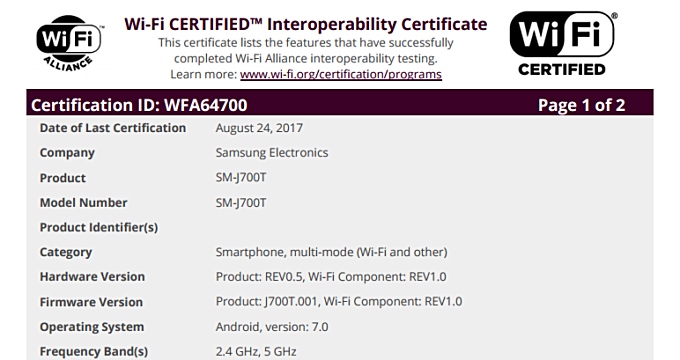
It was June this year, when the first-gen with Android Nougat on board was on the website of WiFi Alliance. Over a couple of months have passed, and the update is yet to roll out. Now, the device has once again appeared on the agency's website, with the listing revealing Android 7.0 this time as well. It's clear that Android 7.0 for the phone is being tested. However, what's not clear is exactly when the update will be pushed out. Getting WiFi certification doesn't necessarily mean roll out is imminent, but it does indicate the update is in pipeline at-least. |